Withdrawal
When you look up the word idiot in the dictionary, you might find a reference to the Greek etymology. The ancient Greeks considered an idiot to be someone ignorant of news and current events, a non-participant in political life.
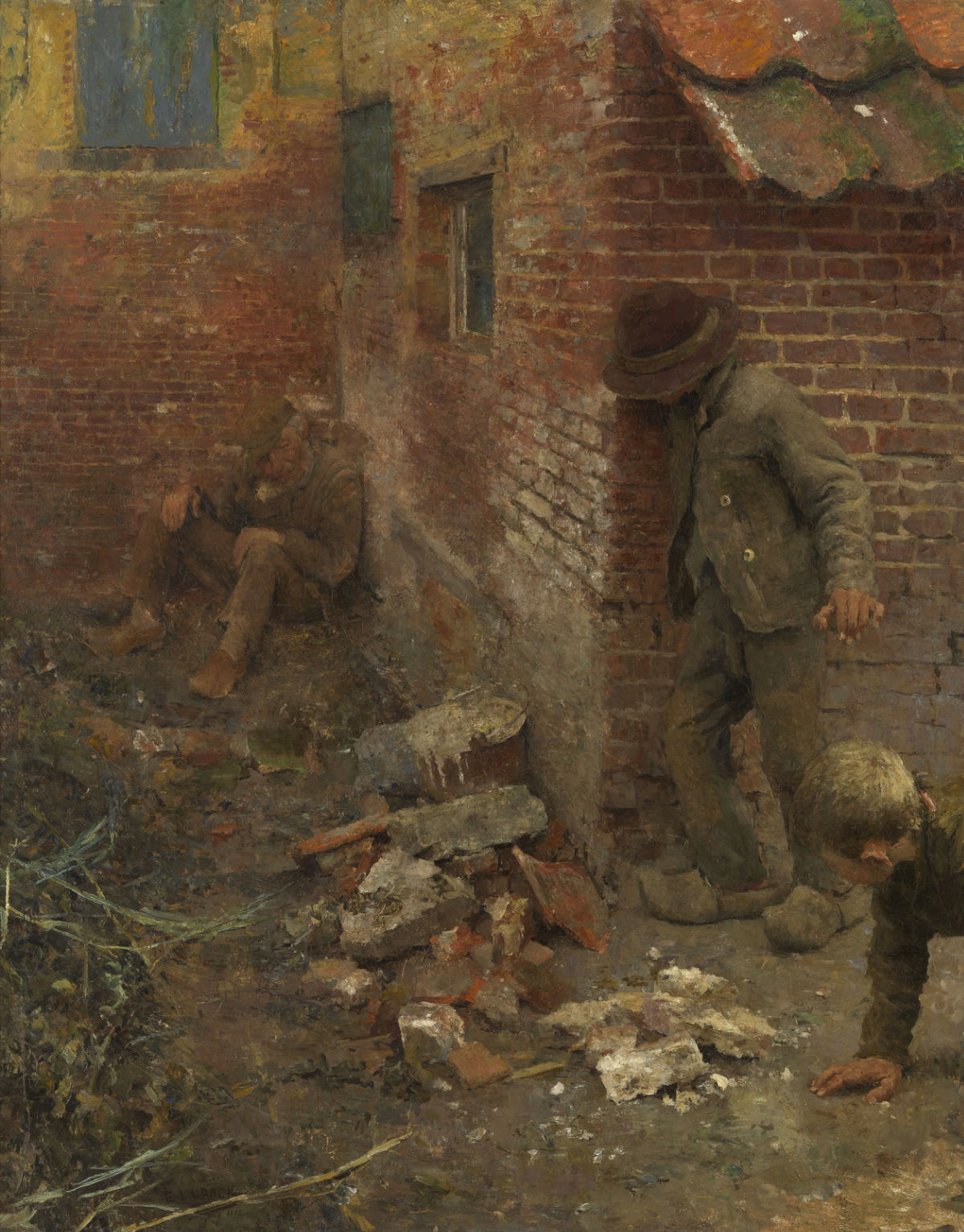
But when you look up idiot in Wikipedia you see a painting by Evert Larock.
The idiot is an old man, cornered and tired, being harassed by a pair of young boys — little arseholes in Dutch clogs — about to throw rocks at him.
A few years ago, I was explaining to a friend that I had stopped reading the news, that I had deliberately decided to retreat from the day-to-day chaos. She insisted that it was a person's civic duty to be aware of the news and politics, basically along the lines of the ancient Greeks, she was suggesting, perhaps, that I was an idiot.
I go through periods, especially when travelling or in waiting rooms, when I install on my phone social networking apps, games, and news readers. I voraciously read and skim, I argue and fight with strangers on the internet for imaginary points, and I play games for increasingly diminished neurochemical returns.
And every time this happens I inevitably reach a point of discomfort, anxiety and anger. No matter how finely tuned, the filters and algorithms still serve up the trite, the dross, the blatantly biased, the uninformed clickbait. And my reactions become less measured, more emotional.
There is always a new outrage, a new scandal or developing situation, and if I'm not able to make a snap judgement there will be plenty of judgements offered for me to rally behind. But whatever it is, I can't do anything about it. No amount of arguing on Reddit or virtue signalling or thoughts and prayers will make any real difference. It's all noise, no signal.
It's one thing for the ancient Greeks to laud civic participation. In a smaller world, a traditionally democratic world, it was possible to make a difference to society and for society to make a dramatic difference to the individual. That no longer seems true.
What I've found is that there is nothing in the news that impacts my life immediately or directly.
There are subjects I find interesting, events that challenge or reinforce the way I look at the trajectory of the world but if they are sufficiently interesting or relevant, I'll find them eventually. And usually, I'll find them once a more thorough, measured and researched article has been written with the benefit of time.
Once again, I find myself deciding to withdraw and go back to being an idiot.
“But I came to see that my love for Emily was the love of a ghost for a ghost, and that the letters I had been writing to her were the letters of an hallucinated man, a man vainly trying to pretend to himself that he was the same man that he had been in 1914.”
— T. S. Eliot, Statement by T. S. Eliot on the opening of the Emily Hale letters at Princeton
“…all photographs are there to remind us of what we forget. In this—as in other ways—they are the opposite of paintings. Paintings record what the painter remembers”
— John Berger
What I Didn't Know Before
was how horses simply give birth to other
horses. Not a baby by any means, not
a creature of liminal spaces, but already
a four-legged beast hellbent on walking,
scrambling after the mother. A horse gives way
to another horse and then suddenly there are
two horses, just like that. That’s how I loved you.
You, off the long train from Red Bank carrying
a coffee as big as your arm, a bag with two
computers swinging in it unwieldily at your
side. I remember we broke into laughter
when we saw each other. What was between
us wasn’t a fragile thing to be coddled, cooed
over. It came out fully formed, ready to run.
— Ada Limón (2018)