There is an interesting video of Nicolas Bourriaud, curator of the 4th Tate Triennial, explaining his conception of Altermodern. Bourriaud is also writing a book, The Radicant. From the publisher’s site:
To be radicant: it means setting one’s roots in motion, staging them in heterogeneous contexts and formats, denying them any value as origins, translating ideas, transcoding images, transplanting behaviors, exchanging rather than imposing. The author extends radicant thought to modes of cultural production, consumption and use. Looking at the world through the prism of art, he sketches a “world art criticism” in which works are in dialogue with the context in which they are produced.
“And if twenty-first-century culture was invented with those works that set themselves the task of effacing their origin in favor of a multitude of simultaneous or successive enrootings? This process of obliteration is part of the condition of the wanderer, a central figure of our precarious era, who insistently is emerging at the heart of contemporary artistic creation. This figure is accompanied by a domain of forms and by an ethical mode: translation, whose modalities and cardinal role in contemporary culture this book seeks to enumerate.”
I suppose the key difference is the Radicant sounds more inclusive while the Nomad is more deliberately making decisions about what should be discarded. Both concepts appeal since they seem to work against any kind of cultural studies approach that great ouroboros and cul-de-sac of academic thought.
Another book to add to the reading pile.
Robert Drewe & Charles Meere
I was a little fuzzy on the details but after seeing a painting last week I was reminded of a story.
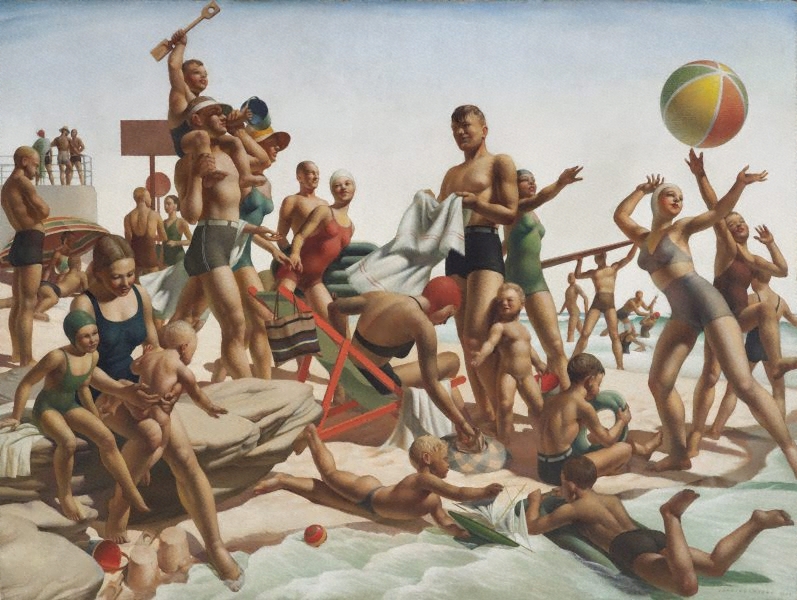
Robert Drewe was scouring through the Art Gallery of NSW looking for an artwork that might suit a book cover. He happened upon ‘Australian Beach Pattern’ by Charles Meere. The AGNSW describes the work as “perennially popular” but until Drewe pulled it from storage it had been “lost”.
That’s the story. Whether it is true, I’m not sure.
Looking at the AGNSW details for the painting they list exhibitions that include the work. After an initial exhibit in 1952, it wasn’t seen again until 1982. The Bodysurfers, Drewe’s collection of stories was published in 1983 using the painting for the cover. The timeline seems to match, taking into account the time involved to create the cover, print the book, etc.
Like Dupain’s ‘Sunbaker’ the painting has become an iconic representation of beach culture but more than that it seems a very nationalistic piece. The child raising a shovel from his father’s shoulders looks almost like a parody of Soviet-era posters, and the father, as well as the man holding the towel in the centre, have a military posture.
Most striking, to me, is the light. It isn’t so much that there is a problem with the direction of the sun but that each person is made up of light and darkness. The painting has depth and perspective, a layering of groups. But there is also tension on each person with the way shadow seems to curve the figures.
Justine
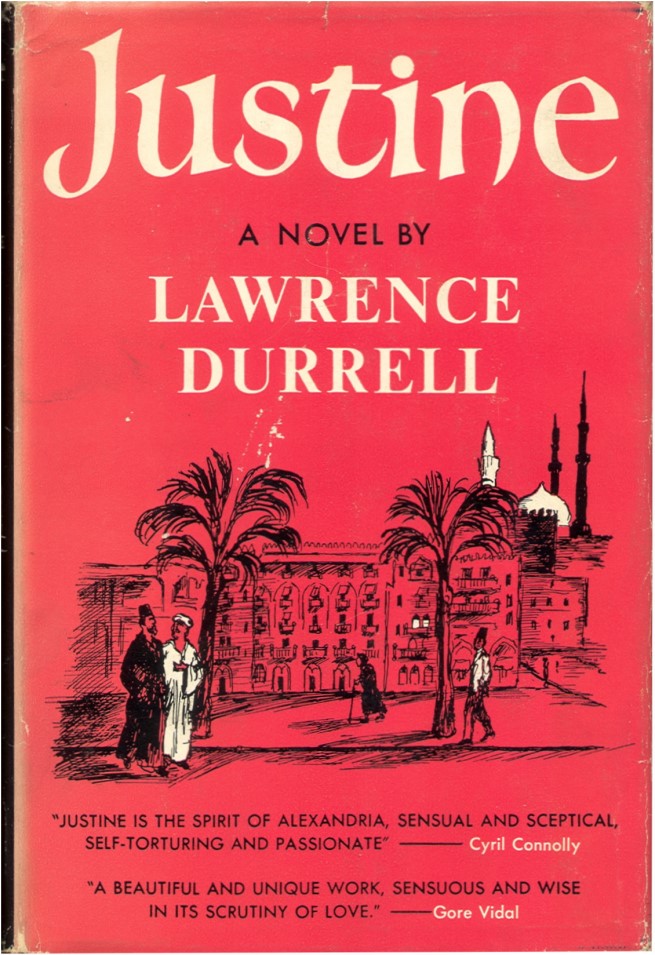
Tonight I finished reading Justine, the first book of the Alexandria Quartet by Lawrence Durrell. The final section:
The cicadas are throbbing in the great planes, and the summer Mediterranean lies before me in all its magnetic blueness. Somewhere out there, beyond the mauve throbbing line of the horizon lies Africa, lies Alexandria, maintaining its tenuous grasp on one’s affections through memories which are already refunding themselves slowly into forgetfulness; memory of friends, of incidents long past. The slow unreality of time begins to grip them, blurring the outlines—so that sometimes I wonder whether these pages record the actions of real human beings; or whether this is not simply the story of a few inanimate objects which precipitated drama around them—I mean a black patch, a green fingerstall, a watch-key and a couple of dispossessed wedding-rings…
Soon it will be evening and the clear night sky will be dusted thickly with summer stars. I shall be here, as always, smoking by the water. I have decided to leave Clea’s last letter unanswered. I no longer wish to coerce anyone, to make promises, to think of life in terms of compacts, resolutions, covenants. It will be up to Clea to interpret my silence according to her own needs and desires, to come to me if she has need or not, as the case may be. Does not everything depend on our interpretation of the silence around us?
Kind of Blue
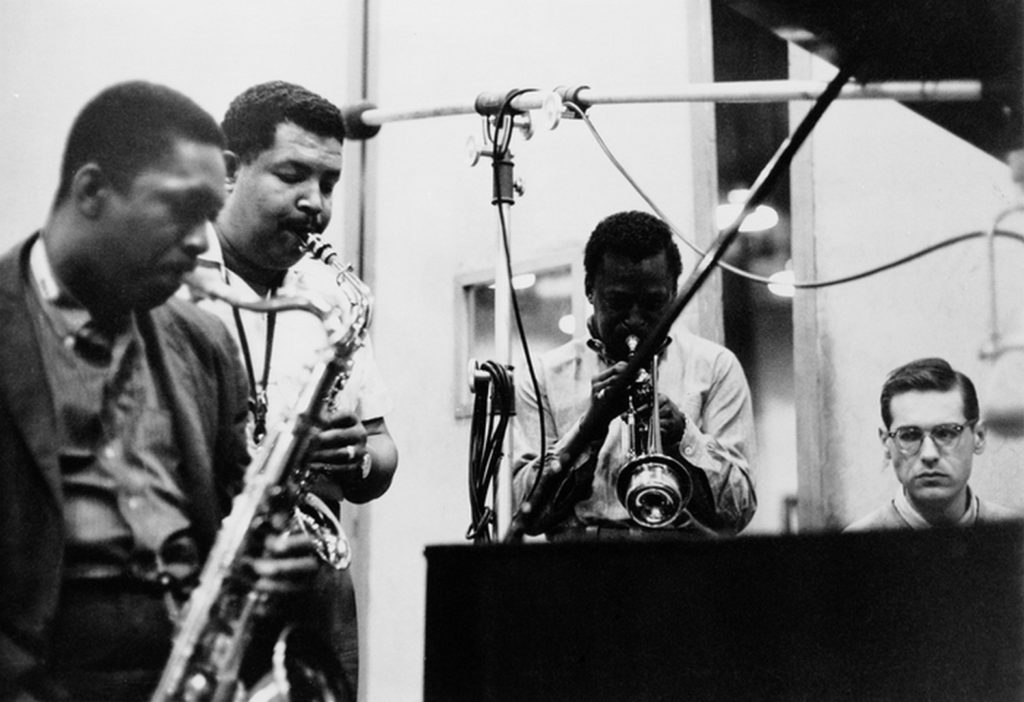
During a recording session (later released as ''58 Miles'), American jazz musicians John Coltrane (1926 - 1967), Cannonball Adderley (1928 - 1975), Miles Davis (1926 - 1991), and Bill Evans (1929 - 1980) perform in the studio, New York, New York, May 26, 1958. (Photo by Frank Driggs Collection/Getty Images)
Today is the fiftieth anniversary of the first recording session for Kind of Blue, the Miles Davis album.
The lauds and honours for the album are well known. It has been placed in the US National Recording Registry in the Library of Congress. It is the best selling jazz album, and Miles Davis album, of all time and continues to sell 5,000 copies every week.
It is also considered by many to be the best and most influential jazz album, assembling some of the greatest musicians of the era at the height of their careers. The album features John Coltrane on tenor saxophone, Julian ‘Cannonball’ Adderley on alto saxophone, Paul Chambers on bass, Jimmy Cobb on drums, Bill Evans and Wynton Kelly on piano, and Miles Davis on trumpet.
Bill Evans, who had been a part of the Davis sextet and was replaced by Wynton Kelly, features on every track except ‘Freddie Freeloader’ and has been given credit for co-writing ‘Blue in Green’ and ‘Flamenco Sketches’. In his autobiography, Davis wrote: “I… planned that album around the piano playing of Bill Evans.” Evans also wrote the liner notes that go some way to explaining the improvisational nature of the recordings:
This conviction that direct deed is the most meaningful reflections, I believe, has prompted the evolution of the extremely severe and unique disciplines of the jazz or improvising musician.
Group improvisation is a further challenge. Aside from the weighty technical problem of collective coherent thinking, there is the very human, even social need for sympathy from all members to bend for the common result. This most difficult problem, I think, is beautifully met and solved on this recording.
…
Miles conceived these settings only hours before the recording dates and arrived with sketches which indicated to the group what was to be played. Therefore, you will hear something close to pure spontaneity in these performances. The group had never played these pieces prior to the recordings and I think without exception the first complete performance of each was a “take.”
Why blog?
I’ve had a blog for several years, many more than the archives might suggest. Originally hand-rolled, then published with Movable Type, now Wordpress. It has been a patchy and infrequent thing. I’ve lost content and deleted items that I felt offered too stark a characterisation or too fundamentalist political ideas.
There have never been any illusions about the process. It is entirely for me. Anything truly personal is offline, penned into books. What is written here is a collection of quotes, links, definitions, things that I have wanted to keep - like a scrapbook. And now I find myself asking my I bother keeping a blog at all.
If it is personal then perhaps it is better kept in a rolling document on my computer or, since it is mainly a collection of quotes and online ephemera poorly compiled, in any of the numerous digital offerings such as Delicious or Google Notebook, two applications that I already use.
And further to the question is why anyone would blog at all.
At a recent conference on social media the presenter distinguished between the “old” generation (above 25) and the new generation of online users by stating that the older users consider everything they do online to be private unless they make it public while the younger generation consider everything they do to be public unless they make it private. It was just the kind of pithy nugget of new media information I wanted to take back to the office.
But it offers no reason, save the ubiquity of Facebook and internet applications, why this should be the case. Blogs, Live Journals, etc are all becoming mainstream. Businesses no longer use them to present a hip, understanding front. They can offer a more personal means of communicating with the public. Which is bollocks; they are a company. The blog might be written by a person but when did we mistake meeting and speaking with somebody with reading a blog post?
I guess that can come down to some semiotic question, some communication studies theoretical argument about how we are ever able to communicate “personally”.
I read a lot of blogs. I have a vast, often interconnected, OPML list of sites and blogs served up through Google Reader. And here the process makes sense.
The inernet is huge and the amount of content, and by that I mean the stuff that I want to read, has become a gigantic rush of white noise. So I gather around various people who, for one reason, post or link, I consider worth watching and this digital collective whittles down the internet into something more manageable.
Some of these people are largely human editors in the way that Yahoo! and Looksmart used to be human editors - serving up links with brief descriptions. Others, like Jason Kottke or Merlin Mann, sometimes accompany links with the kind of insight or original idea that actually contributes to the whole endeavour.
Yet the “whole endeavour” still worries me.
Tonight I read an excellent review in the New Yorker. I really enjoy book reviews - it is one of my favourite sections in the Guardian Weekly. A good review can give an insight into the author, the subject, the historical perspective, even the basic philosophies and thinking behind the act of creating. And tonight, as fantastic James Wood’s analysis of Richard Yates and Revolutionary Road was, I couldn’t shake the feeling that I should have spent the energy reading the actual book.
The New Yorker article was printed from the web, sourced via a blog, and it struck me how incredibly removed from actual things the internet is making me. It goes back the sheer mass of content online but is it better, for me, to have read one thousand blog posts that point to one hundred reviews of books and movies and restaurants than it is to have read a single book, seen a movie or had dinner? An utterly rhetorical and stupid question. I imagine that speaking briefly about a dozen books and films of which I am acquainted through reviews, or even just scores, makes for a wide-ranging, wine-swilling, onanistic dinner party conversation and ultimately a cipher of the individual.
Perhaps it is generous to suggest that blogging was ever anything more, but for the vast majority of people who (like me) aren’t contributing to the conversation, blogging and posting links seems to be a narcissistic urge for publication. It doesn’t even fall into the category of bad art - at least that has the potential to improve and become something greater. Posting links will always be a meta-process.
So where does that leave me? As the person writing the blog isn’t it better to have actually created something worthwhile, something wholly new than spent years compiling and cataloguing links and articles that other people wrote and that further people have already catalogued?
I suppose it comes down to finding a balance between reading and archiving the mass of information that ultimately points to books and films the majority of which go unread and unseen and then stepping away from that entire process and watching a film, working on a book (whether reading or writing) and either doing or creating something.
Which isn’t a long-winded declaration leading to closing my journal. It might mean that I have to think about ways to incorporate what I’m already doing with bookmarks and notebooks so that it keeps this whole process relevant. Or maybe it means that I write longer more thought out, original ideas, start some new fiction, perhaps, and publish something more considered, more real than links.
Oh, and the answer, is because it is easy. It is much easier to blog than it is to create something. And yet it is, it exists, published online and public as a testament to having done something even if blogging is nothing.